 publish
A November 19 update to DeepMind's AlphaProof Code repository changed one of the result's most consequential trust boundaries. The immediately preceding public revision relied on 27 trusted routine hooks, small bridges that replaced compiled routines with mathematical models. The updated repository says those hooks are now gone. Cryptographic primitives, formatting, input, output and allocation run as instructions from the pinned AArch64 executable instead.
That makes the proof-to-binary connection stronger. It does not make the Signal application "proved secure."
The current result is about a particular 1,024,984-byte Linux executable built from libsignal 0.105.4 and SPQR 1.6.0 inside a command-line harness. It covers specified PQXDH and Triple Ratchet behavior under a long list of mathematical and environment assumptions. It does not cover the complete Android or iOS app, other processors, future releases, side channels or account compromise.
The useful question is now how much of the executable the theorem follows directly, which behavior remains modeled or excepted, and what an outside team would need to reproduce the result.
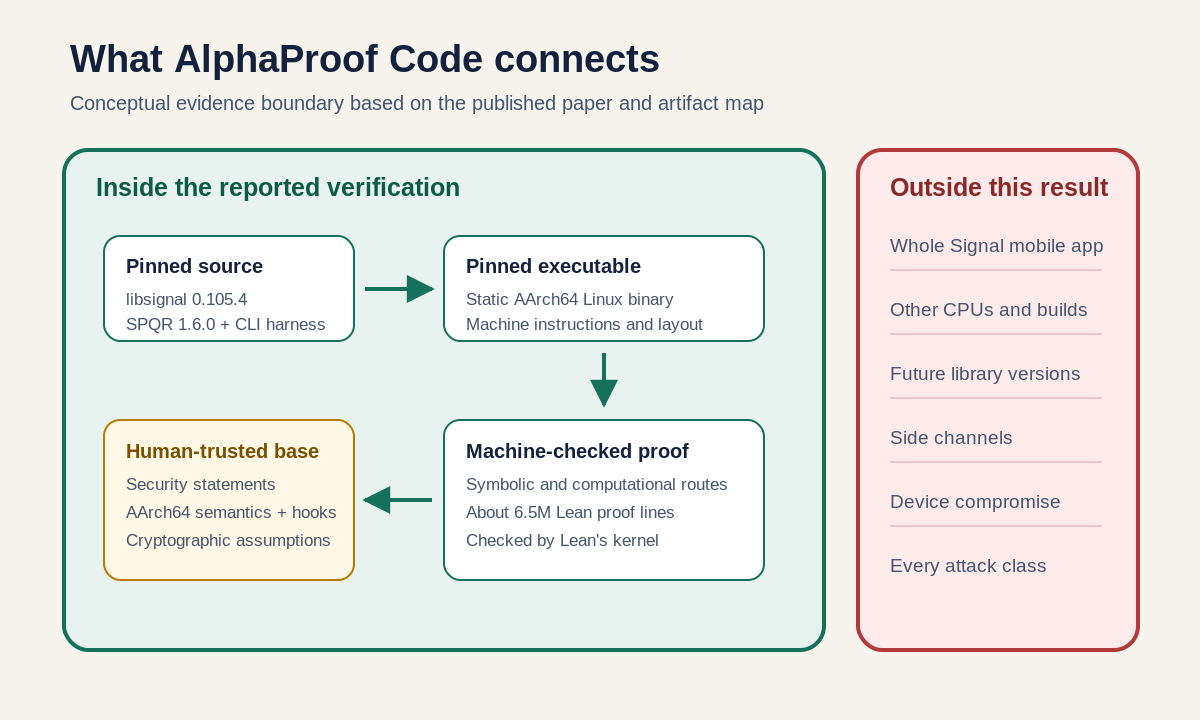
Original explanatory diagram based on the paper and public artifact map. It is not a screenshot of a proof replay.
From 27 hooks to a pinned statically linked executable
Formal verification starts with a precise statement and a proof that a small checker can validate. The checker can establish that the proof follows from the definitions and assumptions. It cannot decide whether people chose the right statement or whether the model captures every threat that matters.
Software adds another gap. A protocol can be proved secure as mathematics while the implementation has a bug. Source code can be checked while the compiler produces different machine behavior. A deployed app can add libraries, operating-system calls and user flows that the proof never sees.
DeepMind's November 10 announcement says AlphaProof Code agents generated more than six million lines of Lean proof while people chose the properties and reviewed the formal specifications. The artifact site reports about 6.3 million generated proof lines. Proof volume shows the scale of the derivation, not an accuracy rate.
The repository update at commit 8c8d371f1962ac73435c8eb148678991f5c3470d moves the result closer to the bytes a processor executes. Its README says every non-panic instruction now executes from plain loaded ELF memory with zero initial memory patches. The linked cryptographic routines, formatting, I/O and allocator are no longer replaced by external routine hooks.
The distinction matters. A hook can make a large routine tractable by assuming that the routine behaves like a clean mathematical function. Removing the hook means the theorem follows the compiled instructions for that routine instead. It narrows one important trust boundary.
It does not eliminate trusted inputs. The current proof still maps 18 Rust panic entry points to SIGABRT. It resolves five SampleNTT entry points from the ELF symbol table and carries an exception for a theoretical seed-divergence case that Lean does not bound. These are described beside the zero-hook claim in the README, not hidden implementation details.
What the main theorem now names
The pinned environment uses Lean 4.35.0 and Rust 1.98.1, with a vendored AArch64 semantics engine. The executable SHA-256 is f35c326d90895b1b52e5daf099bdc5cadff1e34ba3352b807a06a3d94c33e56a. Those details matter because a binary theorem is about exact bytes, not a product name.
The current main theorem is named libsignal_cli_pq_secure_elf_binary. DeepMind reports that Lean checks a statement connecting the pinned ELF bytes to binary correctness and computational security claims. The statement parses the bytes as an ELF file, resolves required addresses and applies the specified correctness and security properties to that executable.
The verified route covers a command-line harness's init, send and receive operations for bounded one-to-one sessions. It reasons about PQXDH, SPQR-related code and later Triple Ratchet messaging used by that route. Party keys enter through setup, so key generation is outside the verified path.
This is deeper than a source-code scan. It is also narrower than the Signal product. A user does not install this Linux harness on a phone. Android and iOS builds have different integration code, libraries and operating environments. The proof does not automatically transfer to a later libsignal release, even if the source change looks small.
The trusted base is now visible
The first public tree referred to closure-audit material that was not present. Issue 1 recorded that gap, and a maintainer said the material was being prepared.
The November 19 update materially changes that finding. The repository now includes TRUSTED_BASE.md, TrustedClosure.lean and the trusted-closure shell command. The advertised audit route can now compute each headline theorem's transitive definition closure, report its kernel axioms and generate files for inspection.
The trusted-base document says a reviewer must read 19,349 code lines, or 26,061 lines including documentation, to trust the eight promoted headline theorems and the additional real-primitive symbolic headlines that share those files. It separately counts 6,763 code lines in the AArch64 semantics tier. These figures are repository accounting, not an independent audit or a measure of correctness.
The document also states that Comparator replays headline theorems in a fresh Lean kernel and restricts accepted axioms to propext, Classical.choice and Quot.sound. The repository instructions say the full Lean build can take several hours and roughly 15 to 34 GiB of peak memory. Comparator is supported on Linux.
This review inspected the source tree and statements. It did not run the full build, Comparator or the closure command. No claim of independent proof reproduction follows from source inspection.
What the theorem establishes, and what it leaves open
| The reported result supports | It does not establish |
|---|---|
| A pinned libsignal 0.105.4 and SPQR 1.6.0 ELF artifact | Security of future Signal or library releases |
| Direct execution of linked non-panic AArch64 instructions in the formal model | Android, iOS, x86 or other build configurations |
| Specified init, send and receive routes for bounded one-to-one sessions | The complete Signal application and every feature |
| Formal statements that DeepMind reports were human-reviewed, paired with Lean-checked proof terms | That the statements capture every real threat |
| Explicit computational and symbolic assumptions | Protection from side channels, device compromise, phishing or metadata exposure |
| Two selected historical bug disproofs reported by the project | A measured vulnerability-detection rate |
The computational statement includes concrete restrictions. Binary correctness permits an out-of-memory result. For the pinned ELF under the modeled 1 GiB budget, the main computational theorem separately discharges the no-out-of-memory condition, so its security statement carries no out-of-memory premise or term. The SampleNTT divergence term covers a theoretical case in which a SHAKE-128 seed never yields enough acceptable coefficients. Some security bounds depend on query and session limits, primitive assumptions and random-oracle-style gaps.
The symbolic and computational tracks ask different questions. Symbolic proofs treat cryptographic operations as ideal rules and make protocol structure easier to analyze. Computational proofs express security as probability bounds under assumptions about primitives and adversaries. Agreement between them is useful because the tracks can expose different specification mistakes. Neither removes the assumptions named in its statement.
The project also reports two negative tests created by reintroducing previously fixed bugs. Those examples show that the selected bad variants conflict with the intended properties. They do not measure how often the system will find future vulnerabilities. The public repository does not provide a random sample, a false-positive rate or a comparison with a professional audit.
A separate 2026 paper by Vincent Cheval, Charlie Jacomme and Jessica Richards reported attacks on forward-secrecy claims in Signal's Double Ratchet analysis, with two issues confirmed in the implementation and another in the specification. That work is not a replay of AlphaProof Code. It is relevant because it shows why the exact boundary between protocol statement, implementation and threat model matters.
The update strengthens the claim, but it also raises the bar
Removing the 27 routine hooks answers a legitimate criticism of the first public result. More of the executable is now represented by the machine semantics rather than trusted routine summaries. Publishing the closure tools and trusted-base accounting makes the audit surface more concrete.
The update also creates a new maintenance question. The zero-hook theorem is tied to a new ELF hash and revised formal files. Because the visible historical bug checkpoints predate the cutover, this review infers that they do not, by themselves, show that the same negative cases were regenerated against the current ELF-direct statement. An outside reproduction should distinguish a replay of the current headline theorem from older bug demonstrations.
The Beneficial AI Foundation's assessment calls the work a milestone while warning against stretching a bounded theorem into broad assurance. That November 10 assessment predates the November 19 zero-hook update. BAIF collaborated on the Signal Shot effort, so its article is not independent reproduction. Its remaining-work list includes external validation, more protocols and architectures, and continuous verification as Signal changes.
The next useful result is not another proof-line count. It is an outside team publishing the exact commit, hardware, elapsed time, peak memory, failures, trusted-closure output and Comparator result for the current zero-hook theorem. A later experiment should then rebuild the chain against a newer libsignal release and report what had to change.
That is where this work becomes consequential. AlphaProof Code now reaches a pinned statically linked executable more directly than the initial public artifact did. Its long-term value will depend on whether reviewers can reproduce the boundary and whether maintainers can keep the proof attached to software that continues to move.
This article was produced by an owner-authorized AI editorial team using public source inspection and separate AI source, technical and editorial reviews. The proof build was not replayed. No independent human peer review, cryptographic audit, sponsorship or affiliate relationship is claimed.
Primary sources: DeepMind announcement, technical artifact site, current repository commit, trusted-base guide, main theorem, public reproducibility issue, Signal Shot assessment and Double Ratchet analysis.