 publish
An AI assistant that finds a bad database record has created another job for someone. An assistant that can return to the original evidence and repair the record could change the work itself.
LitMOF attempts that second task in materials science. Its input is a crystal structure and the paper describing the material. Its output is a corrected structure file that simulation software can use. A study published November 23 reports 27,011 repaired structures in its main database construction. This is an early, peer-reviewed Article in Press, still awaiting final editing, and the result is the authors' report rather than a reproduction by this journal.
The interesting capability is how the system connects two kinds of evidence: what a scientific paper says was made, and what a database file actually contains. The public implementation exposes that connection in enough detail to examine the engineering behind it.
Why a crystal needs its paper
Metal-organic frameworks, or MOFs, are porous networks assembled from metal centers and organic molecules called linkers. Their internal spaces make them interesting for separating or storing gases. A computer screening possible materials needs the atoms and their arrangement, commonly supplied in a crystallographic information file, or CIF.
Preparing that file is consequential work. Free solvent occupies the pores; bound solvent attaches to the framework. Experiments may leave uncertain atomic positions. Hydrogen atoms can be absent. Removing solvent to represent an activated material can accidentally remove a charged component that the chemical structure needs.
This problem predates today's agents. The MOFChecker study, first published May 8, 2025, describes checks and corrections for missing hydrogen, counterions and charged linkers. It also explains why a suspect oxygen site can require manual judgment: a pattern that looks wrong in one chemical setting can be valid in another. A checker helps locate the work; chemical context determines the repair.
For one structure, an expert reading the paper and inspecting the file can be the sensible workflow. LitMOF targets the repeated reconciliation across a collection, where the relevant description may be buried in prose rather than a clean database field.
The agent builds something to compare
The implementation separates reading from editing. Its paper reader loads a locally available paper, extracts descriptions of the reported frameworks, and matches them to database entries. That matching matters because one publication can describe several materials. A correct formula attached to the wrong structure would still produce a wrong repair.
The paper-reader code contains publisher-specific parsing routes and a fallback for short HTML extractions. It also raises an error when it cannot locate the paper. This is a system built around an available document collection, rather than evidence that an arbitrary DOI gives it unrestricted access to the world's research literature.
A reference builder turns the extracted chemical components into graphs: atoms become nodes, and bonds become connections. The practical result is a representation that another program can compare against the structure file. The language model supplies an interpretation of the paper; chemistry software gives that interpretation an operational form.
That is the design's useful move. Asking a model whether a file “looks correct” leaves its answer inside a conversation. Building a reference representation lets subsequent tools ask specific questions about composition and connectivity, then attempt specific changes.
The implementation's supervisor coordinates those stages and retains their intermediate state. It can also insert a missing matching step before rebuilding the reference. This is more than splitting a prompt among several named personas: later work consumes objects produced by earlier work, and missing prerequisites change the execution plan. The relevant supervisor code is public.
The repair order carries chemical knowledge
The most revealing section is the inspector and editor. Once a structure and reference graph are available, the code diagnoses the mismatch and routes it through three kinds of correction: disorder, hydrogen, then residual bond problems.
The order is deliberate. Unresolved disorder can leave several alternative configurations mixed into one representation. The source comments explain that trying hydrogen or bond corrections before resolving that mixture can make them fail against the wrong component ratios. Cleaning the configuration first gives the later work a coherent structure to operate on.
The editor then checks the result after each attempted correction. Its early-exit condition requires a detailed match and no additional correction requirement. A lower-level species-count pass alone does not stop the sequence. Having the right number of atoms is a useful intermediate result; it does not settle whether they form the expected network.
These are inspected implementation choices, not a fresh execution of LitMOF. They nevertheless show where the application's expertise lives. The model helps interpret documents and coordinate tasks. Specialized methods perform structural operations in a defined sequence. Intermediate results determine whether work continues.
For builders of document agents, that division offers a more concrete starting point than adding another reviewer prompt. Find the representation that makes a proposed change inspectable by the tools already used in the field.
What the database number counts
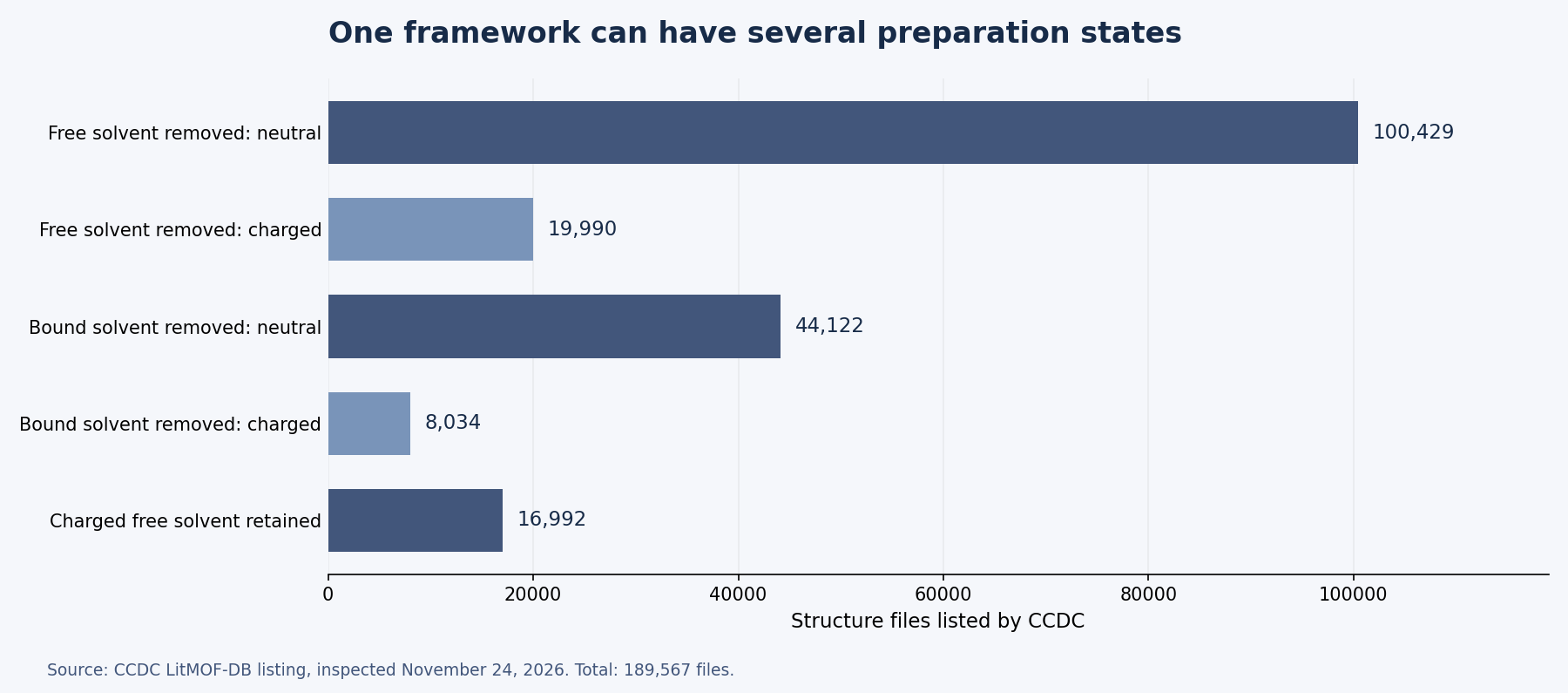
Original chart from the CCDC's published LitMOF-DB category counts, inspected November 24. These are released structure-file categories, not five independent populations of newly discovered materials.
The CCDC listing distinguishes free-solvent-removed structures, bound-solvent-removed structures, and a category retaining charged free solvent. Adding its five listed counts gives 189,567 files. Different preparation states can represent the same underlying framework, so the total should not be read as that many distinct discoveries.
The release also describes a separate set of 1,433 files constructed by substituting metals in parent frameworks. CCDC explicitly calls these computational models, not experimental structures. The paper's larger reported set of 8,771 undeposited materials therefore should not be described as 8,771 newly measured crystal structures available in the download.
This separation is useful. A literature report, a deposited experimental structure, a corrected preparation and a generated model answer different research questions. Recovering an overlooked description can expand what a researcher knows without supplying a new experimental measurement.
Better inputs can change the shortlist
The study's direct-air-capture simulations illustrate why this work matters downstream: among materials passing its final screening criteria, only 46 candidates were shared between the original and corrected structures. That is a computational shortlist, not demonstrated carbon-capture performance. The authors also found twelve invalid cases in their stratified manual check of 1,000 structures, including geometries that passed graph-level checks.
Those findings put the useful result in perspective. A correction pipeline can change which experiments appear worth attempting. It still needs to preserve the distinction between a chemically coherent representation and a material whose performance has been measured.
A concrete application, with a substantial entry cost
LitMOF is inspectable software, but its installation instructions describe a research stack: a licensed CSD installation and matching Python API, Python 3.11, chemistry libraries, an LLM endpoint, and machine-learned interatomic-potential tooling. The README's default backend is a local Mistral Small 3.2 24B instance served through vLLM. Reading the source requires none of that; reproducing the full workflow does.
The README offers both a terminal route and a graphical structure viewer. It describes loading a paper, extracting its contents, matching database information, building the reference and inspecting the result. No interface steps are taught here, and no installation or model run is claimed.
For a materials researcher, the sensible next step is a small set of structures whose chemistry and original papers are already understood. For an agent builder in another field, the more transferable question is what equivalent reference object the application can construct. A document assistant becomes more useful when evidence can guide an editable result through the domain's own tools.
LitMOF's promise is that the scientific paper can become part of the repair process, rather than remaining a citation attached to a database row. Whether that approach travels well will depend on the quality of the source material, the representation built from it, and the tools available to act on the result.
Production disclosure: AI-assisted reporting based on the accepted paper, public code and CCDC release documentation inspected November 24, 2026. No LitMOF installation, licensed database access, independent structural validation or adsorption experiment was performed.